
A flight from or to a Romanian airport that arrives three or more hours late entitles the passenger to a fixed compensation of 250, 400 or 600 euro under EU Regulation 261/2004. The amount depends on the great-circle distance — not on the ticket price, not on the airline’s apology, not on the size of the inconvenience. This page sorts out the rule for a Romanian passenger: when the three-hour threshold actually bites, what the airline owes on top of the cash payment while you are still waiting, when “extraordinary circumstances” really do block the claim and when they do not, and how to escalate through ANPC and the Judecătoria within the three-year prescription window. For the broader picture across all causes, see our EU 261 claim process guide. The CompensaRezbor editorial team checks every figure and deadline against the source.
The three-hour rule: the single most important number to remember
The wording of Regulation 261/2004 does not literally promise cash compensation for delays. The Regulation talks about cancellations and denied boarding in cash terms, and treats delays mainly through the duty of care. The crucial extension came from the Court of Justice of the European Union in Sturgeon (C-402/07, 2009), joined with Böck & Lepuschitz (C-432/07). The Court ruled that passengers who arrive at their final destination three or more hours behind schedule suffer the same loss of time as passengers whose flight was cancelled, and therefore must receive the same fixed compensation. That ruling is now settled law across the EU, applied identically by Romanian courts and by ANPC.
Two things follow from this. First, the clock that matters is the arrival clock, not the departure clock. A flight that leaves Henri Coandă four hours late but, through a tailwind or a shorter holding pattern, lands in Bucharest only two hours and forty minutes after schedule does not trigger the fixed compensation. Conversely, a flight that pushes back from the gate only one hour late but spends three more hours circling because of stack restrictions and lands three hours and twenty minutes late does trigger it. The actual moment that counts is door opening at the gate of arrival.
Second, the threshold is hard. Two hours and fifty-nine minutes late produces no fixed payment, no matter how bad the airline behaved. Three hours and one minute does. The airline cannot negotiate the threshold downward, and you should not let an airline staffer or a chatbot tell you otherwise.
How much: 250, 400 or 600 euro by distance
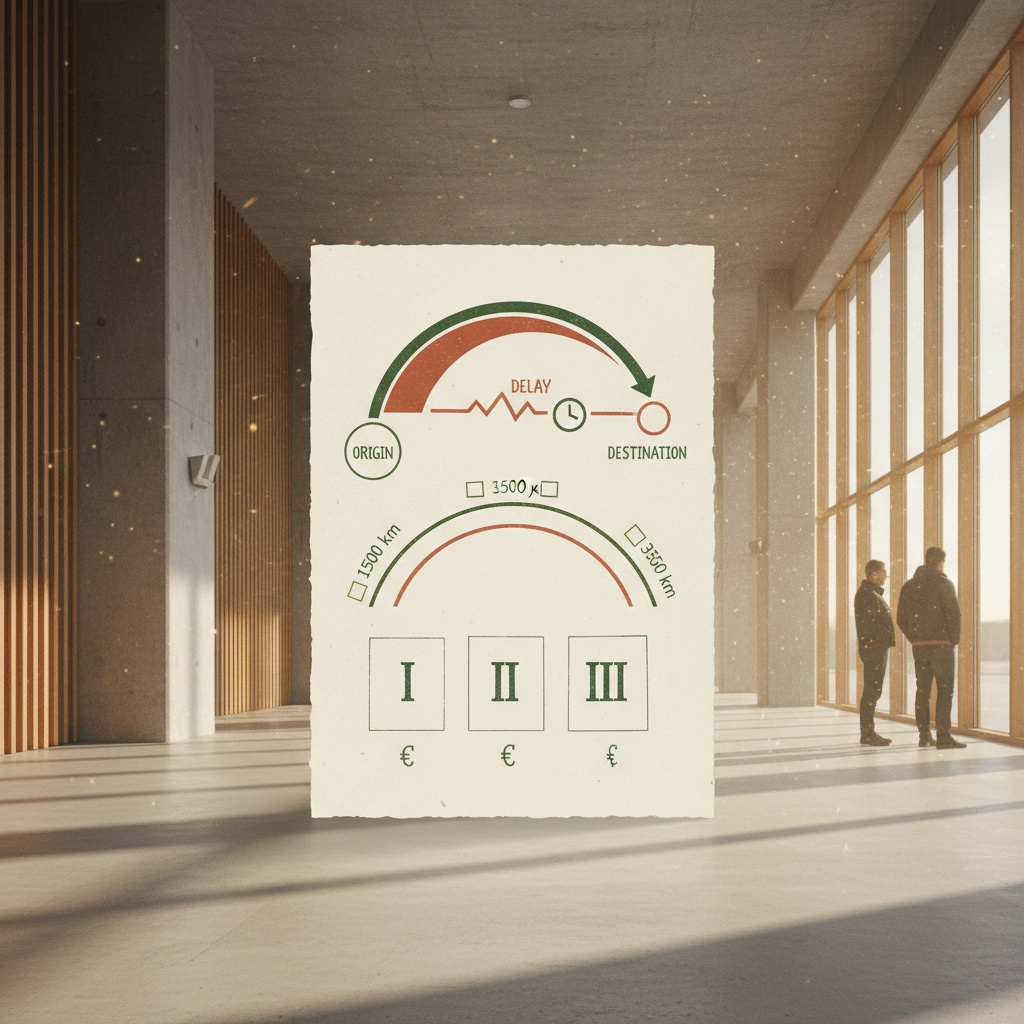
The amount is set by article 7 of the Regulation, by reference to the great-circle distance of the route — measured between origin and final destination of the booking, not segment by segment.
- 250 euro — all flights of 1500 km or less. Cluj to Vienna, Bucharest to Sofia, Iași to Brussels (intra-EU short hops) fall here.
- 400 euro — intra-EU flights over 1500 km, plus all other flights between 1500 km and 3500 km. Bucharest to London, Timișoara to Paris, Cluj to Madrid, and most Romania-to-North-Africa or Romania-to-Israel routes sit in this band.
- 600 euro — non-EU flights over 3500 km. Bucharest to Dubai, Bucharest to Doha, or any Romania-to-USA itinerary on a single ticket falls here, provided the operating carrier is an EU airline on inbound or it departs from the EU.
For the 600-euro band on a long delay (but under four hours), article 7(2) allows the airline to reduce the payment by 50 percent — i.e. to 300 euro. That reduction does not apply to the 250 and 400 bands.
A useful quick-check tool is our flight compensation calculator, which converts your route into the right band without a separate map lookup. Either way, remember the figure is per passenger, in euro, regardless of what the ticket cost.
Distance and band by Romanian origin: a quick reference
For Romanian travellers the band almost always depends on the destination, since Romanian airports cover most of Europe within the 1500 km radius and reach into the 1500–3500 km zone for western Europe, North Africa and the Middle East.
- From Bucharest, Cluj-Napoca, Timișoara, Iași and Sibiu, most flights inside south-east and central Europe fall into the 250-euro band. That includes Vienna, Budapest, Athens, Sofia, Belgrade, Munich and Frankfurt for some routes.
- Northern and western European destinations — London, Paris, Brussels, Amsterdam, Madrid, Barcelona, Stockholm — usually fall into the 400-euro band.
- Long-haul itineraries booked on a single reservation — Bucharest to the Gulf, to East Asia, to North America — fall into the 600-euro band.
These bands do not change because you flew on a low-cost carrier. Wizz Air, Ryanair, Blue Air’s successors and any other airline operating from a Romanian airport are bound to the same article 7 amounts as a legacy carrier.
What the airline owes while you are still waiting: the duty of care

The cash compensation is paid afterwards, by bank transfer, on a written claim. While you are still inside the terminal waiting, a separate set of rights kicks in immediately — the duty of care under article 9 of the Regulation. This duty triggers earlier than the compensation: from two hours late on short flights, three hours on medium flights, four hours on long-haul. The airline must provide, free of charge and in reasonable quantity:
- meals and drinks proportional to the waiting time;
- two free telephone calls, emails or fax messages;
- hotel accommodation when an overnight stay is required, plus transport between the airport and the hotel.
The duty of care exists independently of the cash compensation. Even when the delay was caused by a genuinely extraordinary circumstance that blocks the 250–600 euro payment, the carrier must still feed and house you. The CJEU stressed this in McDonagh (C-12/11, 2013): the duty of care is not capped, and it is owed even in the most exceptional disruptions. If the airline staff refuse meals or hotel coverage on the spot, the rule is the same as for cancellation: buy reasonable food, book a reasonable hotel, keep every receipt and submit them with the later claim. For a step-by-step breakdown, see our guide on right to care: meals, drinks and hotel.
Extraordinary circumstances: where airlines push hardest
The most common rejection email runs along the lines of “due to extraordinary circumstances outside our control, your claim is denied”. That phrase is no longer the end of the conversation it once was. Under article 5(3), the airline must prove two things: that the cause was genuinely outside its control, and that the delay could not have been avoided even if all reasonable measures had been taken. The burden sits with the carrier, not with the passenger. The CJEU made this explicit in Wallentin-Hermann (C-549/07, 2008): an ordinary technical fault discovered during routine maintenance is not extraordinary. The same logic excludes most operational shortfalls — late inbound aircraft because the airline’s own rotation slipped, crew running out of duty hours because of poor rostering, missed slots because of slow turnaround.
What does usually qualify as extraordinary: a genuine air traffic control closure (not a five-minute slot reshuffle), exceptional weather on the airport itself, a security threat, a strike by third parties (airport ground staff, ATC controllers, fuel suppliers — but not the airline’s own pilots or cabin crew, per Krüsemann (C-195/17, 2018), see our strike compensation guide), or a bird strike where the safety inspection caused the delay.
What does not qualify: a technical fault detected in the morning checks, a missing cabin crew member, a fuelling delay caused by the airline’s own contractor, a knock-on effect from the airline’s previous rotation. If the airline cites “extraordinary circumstances” but cannot describe a specific event with specific timestamps, you should refuse the rejection and escalate.
For the full taxonomy of what does and does not count, see our deeper guide on extraordinary circumstances under EU 261.
Connecting flights: the Folkerts rule
Romanian passengers often travel via Vienna, Frankfurt, Munich or Istanbul on connecting itineraries booked under a single reservation. Two questions then arise: which leg counts, and who is liable. The CJEU answered both in Folkerts (C-11/11, 2013). The compensation depends on arrival delay at the final destination, not at the connecting hub. So if your Cluj–Munich leg is only mildly delayed but causes you to miss the Munich–Madrid connection and you reach Madrid four hours late, the fixed compensation is owed in the 400-euro band, by the operating carrier of the missed leg.
This matters because airlines sometimes refuse claims on the basis that “your first flight was only two hours late”. Folkerts kills that defence: the arrival delay at the final destination on a single-ticket booking is what governs. For the practical mechanics of how to pursue this — which carrier to address the claim to, how to document the missed connection — see our missed connection compensation guide.
Romanian institutions: who handles the claim
Two routes open if the carrier refuses or stays silent, and none needs a lawyer at the first stage. ANPC takes complaints online in Romanian or English. The Judecătoria hears claims up to 10,000 lei, at either the departure or the arrival airport under Rehder:
ANPC (Autoritatea Națională pentru Protecția Consumatorilor) — the consumer-protection authority — is the everyday first stop for cross-border consumer disputes that involve a Romanian passenger and an airline. It is also Romania’s national enforcement body for Regulation 261/2004, designated by Government Decision (HG) no. 1912/2006. ANPC accepts complaints in Romanian and in English. The path is at anpc.ro and includes online submission. ANPC does not issue binding orders against an airline, but a formal ANPC file generates significant pressure on the carrier’s customer-relations team.
Judecătoria — the local first-instance court — is the final step. A Romanian passenger may file a small-claims action without a lawyer for amounts up to 10,000 lei (well above the 600-euro ceiling). The court venue can be either the airport of departure or the airport of arrival in the EU, under the CJEU’s Rehder (C-204/08, 2009) ruling on jurisdiction. For most Romanian passengers, that means the Judecătoria competent for the relevant Romanian airport — Judecătoria Buftea for Henri Coandă, the Cluj-Napoca Judecătoria for Avram Iancu, and so on. A more detailed walk-through is in our flight compensation court guide.
The three-year prescription period
Romanian law gives a passenger three years to file the claim, counted from the date of the delayed flight, under article 2517 of the Civil Code. The CJEU confirmed in Cuadrench Moré (C-139/11, 2013) that national prescription rules govern EU 261 claims, so three years is the firm Romanian limit. It is not two years (that is the Montreal Convention figure, which applies to damages but not to fixed EU 261 compensation) and it is not five years.
The practical rule of thumb: file the written claim with the carrier within the first one to three months, send a formal reminder if there is no response within six weeks, escalate to ANPC by month four, and if all that has not produced a payment by month nine to twelve, the Judecătoria is the next step. Waiting until year three with nothing on the file is risky — by then evidence of the delay (boarding pass photographs, airport SMS alerts) may be hard to retrieve.
Do it yourself or use a claims service?
You can write the claim and send it yourself; the template is short and the regulatory framework is the airline’s own. What a claims service buys you is the persistence of having a professional chase the airline for months and the willingness to take the case to court if needed, in exchange for a success fee that typically runs around a quarter of the recovered amount.
For most three-hour delays where the airline accepts the cause was within its control, the do-it-yourself route is fine. For cases where the airline insists on an “extraordinary circumstances” defence that you cannot easily disprove from the seat, or for long-haul claims at the 600-euro level where a court action is plausible, a claims service that fronts the litigation risk often pays for itself. Check your Romanian flight delay with AirHelp — no win, no fee. A fuller comparison of both routes is in our claim yourself or use a service guide.
Whichever route you choose, the message is the same: three hours late at the final destination, on a flight from or to a Romanian airport, is the moment your right to 250, 400 or 600 euro becomes concrete. The airline will not volunteer the payment. ANPC and the Judecătoria are there because the system expects you to ask.


No comments yet