
The reform of Regulation (EC) 261/2004, agreed in June 2026 and adopted in July 2026, revises the EU air passenger rights regulation. It does not change the compensation amounts — 250, 400 and 600 euro stay in the text — but it rewrites several of the core terms that decide when compensation is actually triggered: what counts as a delay that grounds a claim, which connecting flights are covered, and what an airline may invoke when it says no. Those are the new definitions in EU 261 2026 that this page walks through, one at a time, with a direct answer on what each one means for a passenger flying to or from a Romanian airport. CompensaRezbor arată, pas cu pas, ce ai de făcut în această situație.
One point first, because it is where most readers slip. This page is about the air-travel reform of Regulation 261/2004, not about the separate rail passenger rights revision. If you searched for “new passenger rights” without specifying the mode of transport, you may have landed in the wrong place: rail and air are governed by different texts.
Compensation is not a refund — and the 2026 reform does not change that
One distinction has to be clean before anything else. Compensation is a fixed 250 to 600 euro for the inconvenience of a long delay, a cancellation or denied boarding; a refund is the ticket price returned when you choose not to travel. Romanian airlines sometimes pay the refund and frame the matter as closed. It is not:
Compensation is a fixed flat sum — 250 to 600 euro — paid for the inconvenience of a long delay, a cancelled flight or denied boarding. A refund is the return of the ticket price when you choose not to travel at all. The reformed regulation keeps the two apart exactly as 261/2004 does. You can be entitled to both at once — for example when a flight is cancelled: a refund for the unused ticket and compensation for the inconvenience. The reform does not touch that split.
This is worth stating plainly because Romanian airlines sometimes offer a refund and frame the matter as closed. It is not. If the cancellation meets the conditions in Article 5 of 261/2004 — and the parallel provisions of the reformed regulation — the compensation is owed on top of the refund.
What counts as a delay that grounds compensation
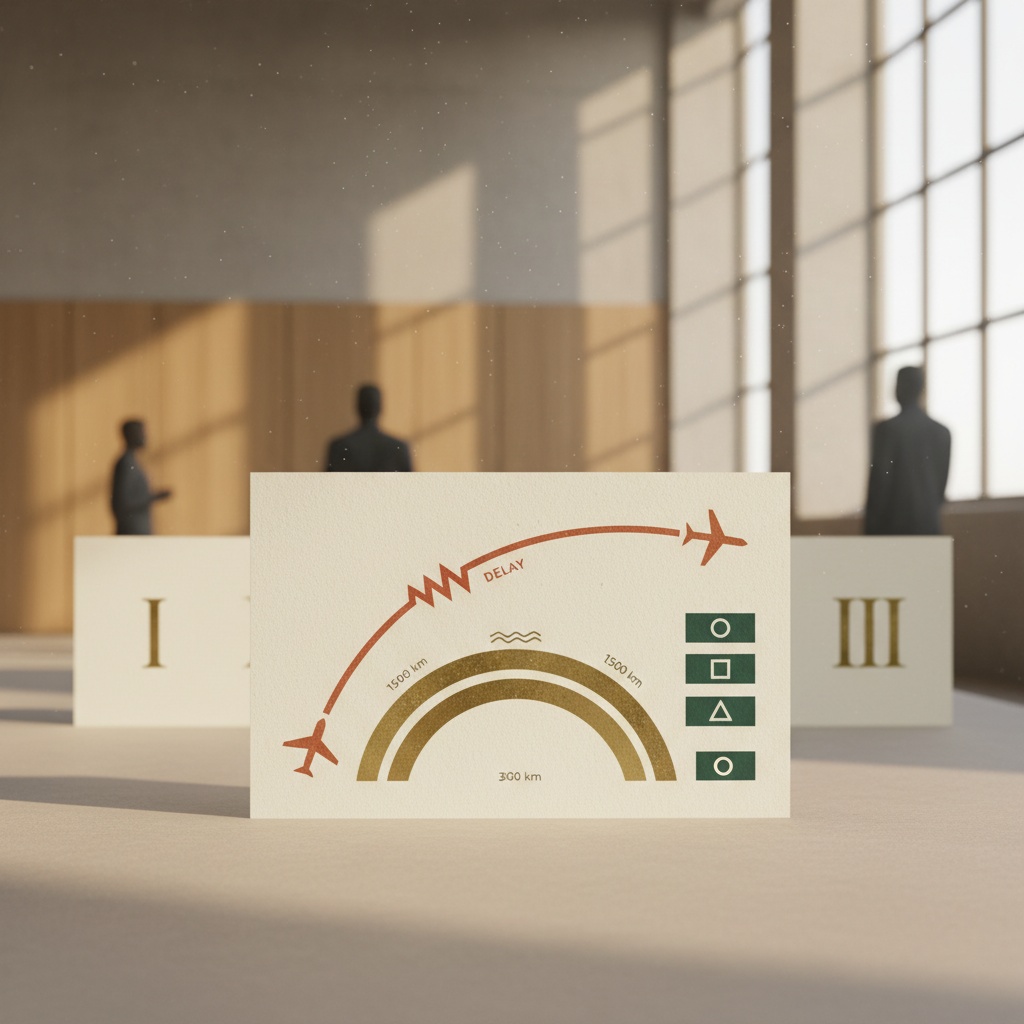
Under 261/2004, the central rule has grown out of CJEU case law rather than the text of the regulation itself: a delay of three hours or more on arrival at the final destination is treated as equivalent to a cancelled flight for the purpose of compensation. The leading judgment is Sturgeon (joined cases C-402/07 and C-432/07, 2009). The fact that the rule has rested on a court ruling rather than on an explicit article in the regulation has been a structural weakness — easier for airlines to contest, harder for a consumer body like ANPC to enforce without referring back to the case.
The stated aim of the reform is to write the delay threshold straight into the regulatory text. That is a substantive improvement: a rule in the text of the law is harder for a carrier to dispute than a reference to a 2009 judgment. We work through how the time thresholds change in 2026 in a section of its own.
The adopted reform settles where the threshold lands. The Council of the EU position from June 2025 wanted to raise the threshold for shorter flights — four hours rather than three was on the table. Later trade reporting points the other way and states that compensation will continue to be paid after a three-hour delay regardless of distance. The consolidated text on EUR-Lex will carry the final wording, and the reform adopted in July 2026 keeps three hours. For any flight disrupted right now from a Romanian airport, the three-hour rule from Sturgeon applies.
Connecting flights: which journey is assessed
Here the reform delivers a concrete improvement for anyone flying with connections — which describes a large share of itineraries out of Otopeni, Cluj or Timișoara when the destination is overseas or transatlantic.
Under 261/2004, the recurring point of dispute has been what happens when a passenger misses a connection: is each leg assessed in isolation, or the booking treated as one journey? The Court of Justice has, across several rulings — Folkerts (C-11/11, 2013) and Wegener (C-537/17, 2018) in particular — held that a booking with a connection is a single contract of carriage and that it is the delay at the final destination which counts. Even so, that position has rested on case law rather than on an explicit article.
The 2026 reform writes this into the text. A single booking is assessed as one journey, and the arrival time at the final destination is the measure.
What this means for a passenger in Romania. If you book a chain such as Bucharest → Frankfurt → São Paulo on one ticket and arrive late because the Bucharest leg ran short on the connection at Frankfurt, the claim is assessed on the full journey to São Paulo. The airline cannot dismiss the case on the grounds that the leg out of Bucharest was short in itself. If, on the other hand, you booked the legs separately with different carriers — Bucharest → Frankfurt on one ticket, Frankfurt → São Paulo on another — the position is materially weaker, and the reform does not change that.
More on the practical side is on our breakdown of compensation for a missed connecting flight.
Extraordinary circumstances — and what force majeure is not

Airlines do not owe compensation when the disruption was caused by extraordinary circumstances outside their control. The term has been in 261/2004 from the outset but never exhaustively defined in the text, which has made it an elastic clause — and carriers have stretched it.
The CJEU has filled in the gaps case by case. Wallentin-Hermann (C-549/07, 2008) ruled that a technical defect identified during regular maintenance is not an extraordinary circumstance — it is part of the carrier’s normal activity. Krüsemann (C-195/17, 2018) held that a wildcat strike by the airline’s own crew is not extraordinary either, because employer-employee relations are part of business risk. Those judgments form the spine of how ANPC examines refusals based on force majeure.
The reform tightens the wording without overturning the principle. A concrete signal from the reform debate is that higher fuel prices are not force majeure. Put plainly: an airline cannot cancel a departure for pure cost reasons and then call it a circumstance outside its control. What continues to count as extraordinary — extreme weather grounding aircraft, air traffic control strikes, security threats, certain bird strikes (compare Pesková, C-315/15, 2017) — does not change in substance.
One important right does not change at all: the duty of care. Even when compensation falls away because the disruption was genuinely extraordinary, the airline’s duty to look after the passenger remains — meals, drinks, communications and, where overnight, a hotel and transport to it. That applied under 261/2004 and continues to apply under the reformed regulation. We cover the practical side on our page about the right to care: meals and hotel.
Romanian enforcement: ANPC and the Judecătoria
New definitions matter only if there is a workable path to enforce them, and in Romania that path runs through two institutions: ANPC, Romania’s national enforcement body for Regulation 261/2004, designated by Government Decision (HG) no. 1912/2006, and the Judecătoria, normally the court of the departure or arrival airport, for small civil claims:
ANPC — Autoritatea Națională pentru Protecția Consumatorilor. The general consumer protection authority. A passenger can file an aviation complaint with ANPC when an airline refuses or delays compensation. ANPC investigates, can apply administrative sanctions, and acts as the first formal escalation after the carrier’s own complaint channel.
Judecătoria. The court of first instance for small civil claims, including most EU 261 actions for Romanian passengers. The Judecătoria with territorial competence is normally, under Rehder (C-204/08, 2009), the court of the departure or arrival airport. A claim of 250 to 600 euro falls comfortably within the small-claims threshold and does not require a lawyer in the strict sense, although passengers often choose representation for the procedural steps.
The CJEU position in Cuadrench Moré (C-139/11, 2013) confirms that national prescription periods govern EU 261 claims. In Romania the general prescription period is 3 years from the date the right becomes due — that is, from the date of the disrupted flight. The 2026 reform does not change this. A passenger has three years to bring an action at the Judecătoria, regardless of whether the disruption was governed by 261/2004 or by the reformed regulation. After three years the right is barred and the court will reject the action even if the underlying claim was sound.
Not legal advice
This page is based on EUR-Lex, CJEU case law and published institutional sources — final expert review is still pending where the consolidated 2026 text is in flux. For advice on an individual case, contact ANPC (Autoritatea Națională pentru Protecția Consumatorilor). For a Romanian-language version of this guide, see the definițiile noi din EU 261 2026 pe varianta în română.
The rules around the 2026 reform are in transition and the wording of the final text may still be adjusted. We date and update this page when EUR-Lex or the CJEU publishes something new.
Not sure whether your flight from a Romanian airport qualifies under the new 2026 definitions?Use a no-win-no-fee service to assess the case in 3 minutes and handle every step with ANPC and — if needed — the Judecătoria, in either Romanian or English. Check my flight under EU 261 2026 →
Frequently asked questions
The questions below close the definitions guide, starting with the one that decides everything else: whether the new 2026 definitions already apply to a flight disrupted today out of Bucharest, Cluj, Timișoara or Iași — they do not, because the substantive rules take effect only after the transition period.
Do the new EU 261 2026 definitions apply to my flight from a Romanian airport today?
No. For a flight disrupted today out of Bucharest, Cluj, Timișoara, Iași or any other Romanian airport, EU 261/2004 still applies. The reform was adopted in July 2026, and its rules apply no earlier than 2027. The set of rules governing a claim is fixed by the date of the disruption, not by the date you file with the airline or ANPC.
Do the 250, 400 and 600 euro amounts change under the reformed regulation?
The amounts stay the same in the adopted text — 250 euro up to 1,500 km, 400 euro for intra-EU flights over 1,500 km and other flights between 1,500 and 3,500 km, and 600 euro for non-EU flights above 3,500 km. The reform does not adjust the figures; it rewrites the definitions that decide when the right is triggered. The fuller breakdown is on EU 261 2026 delay thresholds.
What is the difference between compensation and a refund for Romanian passengers under the 2026 reform?
Compensation is a fixed flat sum in euro for the inconvenience of a long delay, cancellation or denied boarding — 250 to 600 euro. A refund is the return of the ticket price when you choose not to travel. The reformed regulation keeps the two rights apart in the same way as 261/2004. A passenger in Romania may in some cases be entitled to both — refund plus compensation — for a single cancelled flight.
Does Romania still apply the 3-year prescription period for EU 261 claims after the 2026 reform?
Yes. The Court of Justice in Cuadrench Moré (C-139/11, 2013) confirmed that national prescription periods apply to EU 261 claims. Romanian civil law fixes the general prescription period at 3 years from the date the right becomes due — the date of the disrupted flight. The 2026 reform does not change that. A passenger has three years to bring an action at the Judecătoria.
Will the definition of extraordinary circumstances be narrower in EU 261 2026?
The reform keeps the principle but ties the wording closer to existing CJEU rulings. Wallentin-Hermann (C-549/07, 2008) on technical defects and Krüsemann (C-195/17, 2018) on wildcat strikes already mark the practical limits. Pure cost factors such as a fuel price spike are not extraordinary. For Romanian passengers this means ANPC and the Judecătoria have a clearer template against which to test airline refusals.
Sources and further reading
- EUR-Lex — Regulation (EC) No 261/2004
- Court of Justice of the EU — Sturgeon and Others, joined cases C-402/07 and C-432/07 (2009); Wegener, C-537/17 (2018); Wallentin-Hermann, C-549/07 (2008); Krüsemann, C-195/17 (2018); Cuadrench Moré, C-139/11 (2013)
- ANPC — Autoritatea Națională pentru Protecția Consumatorilor (consumer authority, Romania)
If you want the wider overview, our breakdown of extraordinary circumstances under EU 261 covers the case-law spine in detail, and flight compensation at court walks through the Judecătoria procedure step by step.


No comments yet