
If your flight from Timișoara Traian Vuia airport (IATA code TSR) is delayed by three hours or more on arrival, cancelled within 14 days of departure, or you are denied boarding because of overbooking, EU Regulation 261/2004 entitles you to a fixed compensation of 250, 400 or 600 euro per passenger — in addition to refunds, meals, drinks and a hotel where applicable. This page sets out what the regulation means concretely for a passenger flying out of TSR, which Romanian institutions handle the claim, and the three-year deadline that decides how long the right stays alive. CompensaRezbor explains, step by step, what to do in this situation.
TSR airport in plain numbers
Timișoara Traian Vuia is the third-busiest airport in Romania after Bucharest Henri Coandă (OTP) and Cluj-Napoca (CLJ), and the main gateway for the Banat region and the cross-border catchment that includes Arad, Reșița and parts of Serbia and Hungary. The airport handles roughly 1.5 to 2 million passengers a year in normal traffic conditions.
The carrier mix matters because it shapes how your claim plays out in practice:
- Wizz Air — the dominant low-cost carrier at TSR, with a permanent base and a long list of destinations across Western Europe, the UK and Italy. Wizz Air is an EU carrier registered in Hungary, fully bound by EU 261.
- Lufthansa, Austrian Airlines, KLM, LOT, Turkish Airlines — legacy carriers operating connecting feeder flights to Munich, Frankfurt, Vienna, Amsterdam, Warsaw and Istanbul.
- Ryanair, easyJet (seasonal) — additional EU low-cost competition on selected Western European routes.
- TAROM — the Romanian national carrier, primarily on the Timișoara–București domestic link and a handful of regional routes.
Every flight departing from TSR is covered by EU 261 regardless of the airline’s nationality. Every flight arriving at TSR is covered only when operated by an EU carrier (or a Swiss / Norwegian / Icelandic equivalent). A Turkish Airlines flight from Istanbul to Timișoara that runs four hours late, for example, falls outside EU 261 because the operating carrier is non-EU and the flight originated outside the EU. The same airline flying you Timișoara to Istanbul is fully inside the regulation.
What disruption triggers a claim from TSR
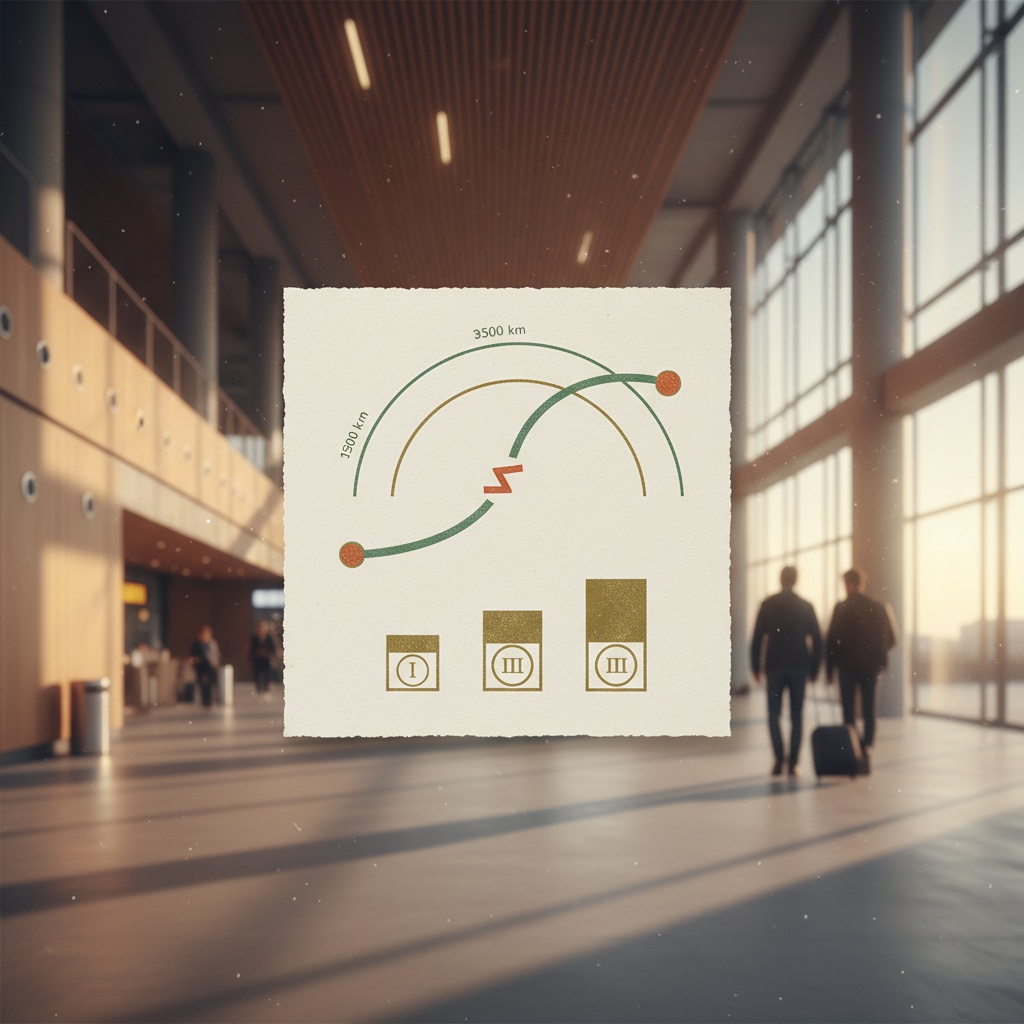
Three fact patterns trigger a TSR claim. A long delay counts when arrival at the final destination is three hours late, so a two-hour push-back that still lands on time pays nothing while an on-time departure arriving 3h 15min late falls in the 400 euro band. A cancellation notified inside fourteen days pays unless the airline proves an extraordinary circumstance. Denied boarding pays at the airport once volunteers are exhausted.
Long delay. The Court of Justice held in Sturgeon (joined cases C-402/07 and C-432/07, 2009) that a delay of three hours or more at the final destination is treated, for compensation purposes, the same as a cancellation. The clock runs against your actual arrival at destination, not against your departure from TSR. If your Timișoara to Madrid flight pushes back two hours late but reaches Madrid at the scheduled time, no fixed compensation is due. If push-back is on time but Madrid arrival is 3h 15min late, you are in the 400 euro band.
Cancellation. If the airline cancels and gave you notice less than 14 days before scheduled departure, fixed compensation is due unless the airline can prove an extraordinary circumstance. You always keep the parallel right to a refund or re-routing, regardless of the cause.
Denied boarding. If the flight is overbooked and you are bumped against your will, compensation is owed immediately at the airport. The carrier must first call for volunteers; only after volunteers are exhausted may it deny boarding involuntarily, and the affected passenger is then entitled to the EU 261 amount on the spot.
The amounts: 250, 400 and 600 euro from Timișoara
Compensation follows great-circle distance, not ticket price, and is denominated in euro under article 7. From Timișoara most Wizz Air, Lufthansa and Austrian routes — București, Vienna, Munich, Frankfurt — sit inside the 250 euro band, while London, Madrid, Lisbon and the Canaries reach 400 euro. Genuine long-haul departures are rare, but a connecting itinerary on one reservation can still trigger 600 euro:
| Route example from TSR | Distance | Compensation |
|---|---|---|
| Timișoara → București | ~430 km | 250 EUR |
| Timișoara → Munich | ~780 km | 250 EUR |
| Timișoara → Vienna | ~440 km | 250 EUR |
| Timișoara → Frankfurt | ~1,060 km | 250 EUR |
| Timișoara → London Luton | ~1,820 km | 400 EUR |
| Timișoara → Madrid | ~2,200 km | 400 EUR |
| Timișoara → Dubai (non-EU, >3,500 km) | ~4,000 km | 600 EUR |
Most Wizz Air, Lufthansa and Austrian routes from Timișoara sit inside the 250 euro band. The 400 euro band kicks in for the longer Western European destinations such as London, Madrid, Lisbon and the Canary Islands. Genuinely long-haul departures from TSR are rare, but a connecting itinerary booked as a single reservation can still trigger the 600 euro band — see our missed connection compensation guide for how the connecting-flight rule works.
When the airline tries to escape — extraordinary circumstances

The commonest defence from TSR is extraordinary circumstances, and both the Court of Justice and Romanian Judecătoria rulings police it tightly. Wallentin-Hermann put technical defects found in normal operation outside the exemption, so a «technical issue» almost never defeats a claim. Genuine causes are severe weather closing the airport, an external ATC strike, a security alert or political instability. The burden of proof sits on the airline:
In Wallentin-Hermann (C-549/07, 2008) the Court ruled that technical defects discovered during normal operation are not extraordinary — they are inherent to running an airline. A “technical issue” with the aircraft therefore almost never defeats a claim at TSR. Genuine extraordinary causes include severe weather actually closing the airport, an air traffic control strike outside the carrier’s sphere of control, a security alert, or political instability at a destination airport.
| Cause cited by the airline | Within carrier’s control? | Compensation normally? |
|---|---|---|
| Technical fault on the aircraft | Yes | Yes — Wallentin-Hermann |
| Late inbound aircraft / "rotational delay" | Yes (in most fact patterns) | Yes |
| Crew shortage, sickness, scheduling | Yes | Yes |
| Fog or thunderstorms closing TSR | No | No |
| Romanian ATC strike, foreign airspace closure | No | No |
| Security alert at the destination airport | No | No |
The burden of proof lies on the airline, not on the Romanian passenger. A short reply citing “operational reasons” or “technical issues” does not discharge that burden. If the airline’s rejection letter contains no documentary proof — no AACR notification, no NOTAM reference, no incident report — the Judecătoria is highly likely to side with the passenger.
How a Timișoara passenger collects the money
The right comes from EU law but the money runs through Romanian institutions, in three steps. A written claim to the operating carrier with thirty days to reply and dated proof of submission. Then ANPC, which applies commercial pressure on airlines with a Romanian presence. Finally Judecătoria Timișoara, where claims under 10,000 lei run in the simplified procedure without a mandatory lawyer.
Step 1 — written claim to the airline. Always start with the operating carrier, not the travel agent and not the airport. Use the airline’s online claim form or send a formal letter to the claims department. Give the airline 30 days to respond and keep dated proof of submission.
Step 2 — ANPC. If the airline refuses or stays silent, file a complaint with ANPC (Autoritatea Națională pentru Protecția Consumatorilor), Romania’s national enforcement body for Regulation 261/2004, designated by Government Decision (HG) no. 1912/2006. ANPC handles consumer disputes generally and can apply commercial pressure on airlines with a Romanian presence, including Wizz Air, TAROM and the European legacy carriers operating from Timișoara.
Step 3 — Judecătoria Timișoara. The decisive route, and usually the fastest. The CJEU confirmed in Rehder (C-204/08, 2009) that a passenger may sue at either the departure airport or the destination airport. For a flight out of TSR, the Judecătoria Timișoara is the competent small-claims court. For amounts under 10,000 RON — which covers every individual EU 261 claim up to 600 euro plus interest and costs — the simplified procedure under article 1026 of the New Code of Civil Procedure applies: low court fee, no mandatory lawyer, judgment generally inside 30 to 60 days.
For the procedure in detail, see our step-by-step guide on how to file a flight delay claim from Romania and our Romanian-language version of the Timișoara airport page.
The three-year prescription period
Romania applies a three-year prescription period to EU 261 claims under article 2517 of the Romanian Civil Code. This is the general limitation period for consumer obligations and the one Romanian courts have consistently applied to air-passenger compensation. The CJEU confirmed in Cuadrench Moré (C-139/11, 2013) that EU 261 claims are governed by national limitation periods — there is no uniform EU-wide deadline.
The practical consequence for a Timișoara passenger: a flight disrupted on 1 April 2024 must be the subject of a court claim filed by 1 April 2027. After that date even a clearly meritorious claim will be rejected by a Judecătoria as time-barred. The clock runs from the date of the disrupted flight, not from the date of the airline’s first refusal letter and not from the last round of correspondence.
This window is materially shorter than in Spain, which allows five years, but longer than in Poland, where the limit is one year. If you are approaching the deadline and the airline is still stalling, the safer move is to file at the Judecătoria Timișoara directly rather than continue exchanging emails.
For the consolidated text of the regulation itself, see Regulation (EC) No 261/2004 on EUR-Lex, in particular article 5 (cancellations), article 6 (delays) and article 7 (compensation amounts).
Get the claim moving without the paperwork
If your TSR flight was disrupted and you would rather not chase the carrier yourself — especially if the airline is non-EU, slow to respond, or has already issued a flat rejection — a specialised passenger-rights service handles the entire procedure on a no-win, no-fee basis. The service files the airline claim, escalates through ANPC, and litigates at the Judecătoria if needed. If the claim succeeds, the service keeps a commission (typically around a quarter); if it fails, you pay nothing.
Check your Timișoara flight in two minutes with AirHelp — no win, no fee
This is not legal advice
This page is based on published EU sources and Romanian institutional practice. For advice on your individual case, contact ANPC (Autoritatea Națională pentru Protecția Consumatorilor), the National Enforcement Body for air passenger rights in Romania, or consult a lawyer authorised to practise in Romania.
Sources and further reading
- EUR-Lex — Regulation (EC) No 261/2004 consolidated text
- CJEU Sturgeon, joined cases C-402/07 and C-432/07 (2009) — long delay treated as cancellation for compensation
- CJEU Wallentin-Hermann C-549/07 (2008) — technical defects are not extraordinary circumstances
- CJEU Cuadrench Moré C-139/11 (2013) — national prescription periods apply to EU 261 claims
- CJEU Rehder C-204/08 (2009) — jurisdiction at departure or destination airport
- ANPC — Autoritatea Națională pentru Protecția Consumatorilor


No comments yet