
Extraordinary circumstances is the defence an airline leans on when it refuses to pay EU 261 compensation. It sits in article 5(3) of Regulation 261/2004, and it says the fixed amount — 250, 400 or 600 euro — does not have to be paid when the cause of the disruption was genuinely outside the carrier’s control and could not have been prevented even with all reasonable measures. The single point most Romanian passengers miss: this is a narrow exception, not a general escape clause. The Court of Justice of the European Union has interpreted it strictly for more than fifteen years. A standard email that mentions an “operational issue” or an “event beyond our control” is wording, not legal proof — and a Judecătoria in Bucharest, Cluj or Timișoara will treat it that way. CompensaRezbor keeps this guide aligned with the primary sources and current case law.
This page works through the exception cause by cause for a Romanian passenger: what the CJEU has actually decided, where weather and ATC and bird strikes really do remove the right to compensation, where airlines stretch the term beyond its limits, and how to push back when the carrier’s refusal does not survive scrutiny.
Compensation is not a refund, and the cause only blocks one of them
One distinction has to be on the table before we go further, because confusing the two is the most common reason Romanian passengers accept a refusal that should have been challenged.
Compensation is a fixed flat amount — 250 to 600 euro — paid for the inconvenience of a long delay, a cancellation or denied boarding. It is set by the distance of the flight, not by the ticket price.
A refund is something else: the money for the ticket back when the flight is cancelled and you choose not to travel.
An extraordinary circumstance can remove your right to the compensation. It does not touch the refund. If the flight from Henri Coandă to Frankfurt is cancelled because of a snowstorm, you still receive your ticket money back if you do not want to be re-routed. The two rights are assessed separately, and an airline that hands you the refund and treats the file as closed has conflated them.
What article 5(3) actually means
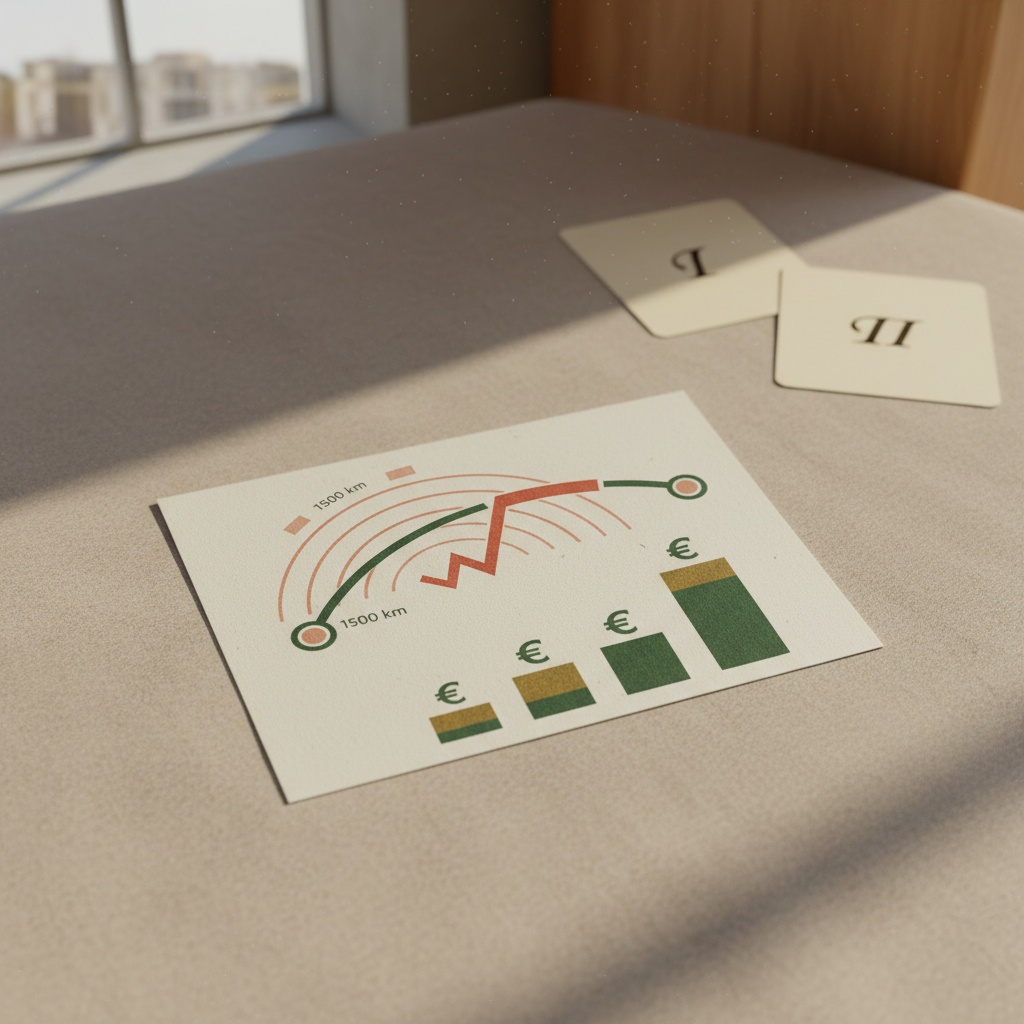
The exception comes from article 5(3) of EU 261/2004. The text itself does not list which events qualify and which do not — and that ambiguity is precisely why airlines have stretched it so far. The CJEU has steadily narrowed the reading, and two conditions must both be satisfied for the defence to hold.
- The event must lie outside the airline’s normal activity and outside its actual control. Anything that belongs to ordinary operations — keeping the fleet airworthy, scheduling crew, handling rotations — is inside the airline’s sphere and therefore not extraordinary.
- The disruption must not have been avoidable even with all reasonable measures. That an extraordinary event happened is not enough. The airline must also prove it could not have worked around it with sensible planning, spare aircraft, reserve crew or schedule buffers.
And the decisive detail airlines almost never volunteer: the burden of proof rests on the carrier. It is the airline that must demonstrate both conditions. A Romanian passenger does not have to prove the cause was ordinary. The default is that compensation is due, and the airline has to displace that default with concrete evidence.
A clear verdict per cause for Romanian passengers
Each common cause has a starting rule. “Depends” in the third column below is not a hedge — it is where most contested cases live, and where airlines push back hardest.
| Cause | Within airline's control? | Fixed compensation normally due? |
|---|---|---|
| Technical fault on the aircraft | Yes | Yes |
| Crew missing or running late | Yes | Yes |
| Wildcat strike by airline's own crew | Yes | Yes |
| Commercial decision (too few bookings) | Yes | Yes |
| Severe weather (storm, fog, snow) | No | No |
| Air traffic control strike or slot closure | No | No |
| Bird strike or wildlife collision | No | Usually no, with caveats |
| Security incident at the airport | No | No |
| Hidden manufacturing defect, sabotage | No | No |
Technical fault — the compensation usually stands
This is the cause airlines invoke wrongly most often. The instinct — “the plane was broken, that is outside our control” — is not how the CJEU reads the regulation. In Wallentin-Hermann (C-549/07, 2008) the Court held that technical problems uncovered during operation or maintenance belong to the very core of running an airline and are therefore not extraordinary. The Court reinforced the line in van der Lans (C-257/14, 2015), ruling that a technical malfunction surfacing in the course of normal operations does not qualify either, even when it appears unexpectedly during a turnaround.
The narrow exception remains for a genuinely hidden manufacturing defect that even the aircraft maker did not detect, or for sabotage. In practice, those scenarios are rare, and the airline has to document them precisely — an internal note saying “technical issue” is not enough. A Romanian passenger whose flight from Otopeni was cancelled “for a technical reason” should treat the compensation as still on the table and ask the airline to specify exactly what failed.
Weather — usually extraordinary, but not a blank cheque
Severe meteorological conditions normally qualify. A storm, heavy snow, dense fog or thunderstorms over the route or at the airport are events the airline does not control, so the compensation typically falls away.
But the question for a Romanian Judecătoria is whether the specific delay was caused by the weather or by the airline’s own handling of it. Did other carriers depart in the same conditions? Was the hold-up because the airline lacked de-icing capacity at Otopeni? Was the crew already out of duty time for an unrelated reason and the weather is just the convenient label? If the weather only added an hour and the airline’s own organisation added five more, the extraordinary defence does not cover the whole delay.
Strikes — the answer depends who is striking
Strikes are the area where airlines and passengers get the rule backwards most often.
A strike by the airline’s own staff — pilots, cabin crew, ground handlers employed by the carrier — is normally not extraordinary. Working conditions belong to the carrier’s sphere. The CJEU settled this in Krüsemann (C-195/17, 2018), where a wildcat sickout by the airline’s own crew did not free the carrier from compensation. So a Romanian passenger whose flight is cancelled because of a Lufthansa pilots' walkout still has a compensation claim.
A strike by outside parties — air traffic controllers, airport security, fuel suppliers — usually is extraordinary, because the airline does not control those workforces. A Romanian flight cancelled because Italian ATC walked out generally gives no compensation.
Bird strike — extraordinary, but only the collision itself
A bird strike counts as an extraordinary circumstance. The Court of Justice settled the point explicitly in Pesková (C-315/15, 2017): a collision with wildlife lies outside the airline’s normal activity and outside its control, so the strike itself gives no compensation.
The judgment goes further. The airline must still demonstrate it took reasonable steps to limit the knock-on delay — inspection, paperwork, re-positioning. If those follow-up steps drag for reasons that were the airline’s own, that portion of the delay may still be claimable, even when the original collision is not.
ATC, slot restrictions and security incidents
Delays caused by air traffic control — congestion, capacity restrictions, slot closures — normally lie outside the airline’s control and give no compensation. The same applies to security alerts and similar external events. As with weather and bird strikes, the airline still has to show it did what it could to limit the effect on your specific flight.
The stacked case — where airlines stretch the exception furthest
The hardest cases for a Romanian passenger are not the clean ones. They are the ones where several things happened in sequence, and the airline points to whichever element looks most extraordinary.
The stacked cause. A thunderstorm gave the aircraft an hour’s delay at Otopeni. That hour pushed the crew past their duty-time limits, and waiting for a relief crew added another four hours. The weather was extraordinary. Crew planning is the airline’s responsibility. The whole delay is therefore not automatically exempt.
The knock-on rotation. Your flight from Cluj to Madrid was late because the same aircraft ran late on an earlier rotation from Madrid to Paris. The CJEU has been clear that an extraordinary event hitting an earlier flight does not automatically taint your flight. The airline has to show it could not have rescheduled or substituted to protect your departure.
The slow recovery. Something extraordinary happened, but the disruption became far longer than it had to be because the carrier had no backup plan, no reserve aircraft and no spare crew. The extra hours sit with the airline’s organisation, not with the original event.
In all three patterns the airline must show it took all reasonable measures, not merely that something extraordinary appeared somewhere in the chain. If it could have done more, the defence does not cover the whole delay — and the compensation, in proportion, survives.
The duty of care never falls away
This is the offset most Romanian passengers forget, and it matters because it is true even on the worst extraordinary-circumstances day. Even when the airline lawfully escapes the fixed compensation, the duty of care under article 9 remains.
The duty of care obliges the carrier to look after passengers while they wait: meals and drinks proportionate to the wait, two phone calls or equivalent communication, and a hotel plus transport if the wait runs overnight or into the next day. The CJEU confirmed in McDonagh (C-12/11, 2013) — the case that followed the Eyjafjallajökull volcanic ash cloud — that even a genuinely extraordinary event does not relieve the carrier of this obligation. There is no proportionality limit and no force-majeure escape.
If the airline points to “force majeure” to refuse food and a hotel at Otopeni, Cluj or Timișoara, that is not correct. Buy reasonable meals, book a reasonable hotel and keep every receipt — the cost is reimbursable. For the full breakdown see our guide to the right to care, meals and a hotel.
How a Romanian passenger pushes back when the airline says no
The right is set by EU 261; how you enforce it is governed by Romanian procedure, and there are two layered routes after the first written complaint to the carrier.
The first stop is always a written claim to the airline, citing article 5(3) and asking for a concrete explanation of the cause. Give the carrier 30 days to respond. If the reply is vague — “operational reasons”, “event beyond our control” — that is not a discharge of the burden of proof.
If the airline refuses or stays silent, escalate to ANPC (Autoritatea Națională pentru Protecția Consumatorilor), Romania’s national enforcement body for Regulation 261/2004, designated by Government Decision (HG) no. 1912/2006. ANPC handles consumer complaints generally and can pressure airlines with a Romanian commercial presence into a settlement.
The second — usually the most decisive — route is a civil claim at the local Judecătoria. Under article 1026 of the New Code of Civil Procedure, the simplified procedure for claims under 10,000 RON applies to every individual EU 261 claim up to 600 euro plus interest and costs: low court fee, no mandatory lawyer, judgment generally within 30 to 60 days. The CJEU confirmed in Rehder (C-204/08, 2009) that a passenger may sue at either the departure or the destination airport, so a Romanian passenger flying Bucharest to Paris can bring the claim at the Judecătoria in Bucharest even if the operating carrier is French.
The prescription period is three years from the date of the disrupted flight, under article 2517 of the Romanian Civil Code. The CJEU confirmed in Cuadrench Moré (C-139/11, 2013) that national limitation periods govern EU 261 claims, so the three-year clock applies in Romania regardless of where the carrier is based. After that date even a manifestly weak extraordinary-circumstances defence will not be reviewed, because the case will be rejected as time-barred.
For the procedural detail see our step-by-step claim guide and the DIY versus claim agency comparison. For the native Romanian-language version of this same article, see circumstanțe extraordinare zbor.
For the consolidated text of the regulation itself, see Regulation (EC) No 261/2004 on EUR-Lex, in particular article 5(3) and article 9.
Get the refusal challenged without the paperwork
If the airline has already replied with an extraordinary-circumstances refusal and you would rather not fight it line by line — especially if the carrier is non-EU or notoriously slow — a specialised passenger-rights service can take the case end to end on a no-win, no-fee basis. The service files the claim, tests the airline’s evidence, escalates to ANPC if needed and litigates where the defence does not hold. If the claim succeeds, the service keeps a commission (typically around a quarter); if it fails, you pay nothing.
Check your refused claim in two minutes with AirHelp — no win, no fee
This is not legal advice
This page is based on published EU sources and Romanian institutional practice. For advice on your individual case, contact ANPC (Autoritatea Națională pentru Protecția Consumatorilor), the National Enforcement Body for air passenger rights in Romania, or consult a lawyer authorised to practise in Romania.
Sources and further reading
- EUR-Lex — Regulation (EC) No 261/2004 consolidated text, article 5(3) and article 9
- CJEU Wallentin-Hermann C-549/07 (2008) — technical defects are not extraordinary circumstances
- CJEU van der Lans C-257/14 (2015) — technical malfunction during regular operation is not extraordinary
- CJEU Krüsemann C-195/17 (2018) — wildcat strike by airline’s own crew is not extraordinary
- CJEU Pesková C-315/15 (2017) — bird strike is extraordinary, but the airline must still limit the knock-on delay
- CJEU McDonagh C-12/11 (2013) — duty of care continues even in genuinely extraordinary events
- CJEU Cuadrench Moré C-139/11 (2013) — national prescription periods apply to EU 261 claims
- CJEU Rehder C-204/08 (2009) — jurisdiction at departure or destination airport
- ANPC — Autoritatea Națională pentru Protecția Consumatorilor


No comments yet