
A bird strike is one of the few flight-disruption causes where the legal answer is fairly clear cut — but only to one of two questions. The main rule: a collision between an aircraft and a bird counts as an extraordinary circumstance under Article 5(3) of EU Regulation 261/2004, so the strike itself normally gives no compensation. This is not airline marketing — the EU Court of Justice settled the question explicitly in the Pešková case (C-315/15, 2017). But the same ruling says something more, and that second half is where this guide becomes useful for Romanian passengers: if a large share of the delay came from the carrier’s own inspection time, missing technicians or admin dragging on, that part can still be claimed under EU 261. CompensaRezbor keeps this guide aligned with the primary sources and current case law.
This page explains exactly where the line falls for travellers flying from Bucharest Otopeni, Cluj-Napoca, Iași, Timișoara, Sibiu or any other Romanian airport, with the CJEU case law that binds Romanian courts and the practical escalation path through ANPC and the Judecătoria.
What the CJEU decided in the Pešková case
The Pešková case (C-315/15) concerned almost the situation Romanian passengers face today: a flight that was delayed by more than three hours after the aircraft collided with a bird. The Czech referring court asked the Court of Justice two questions, and the Court answered both — neither half can be read without the other.
Is a bird strike an extraordinary circumstance? Yes. The Court held that a collision between an aircraft and a bird, together with any damage that follows, is not inherent in the normal exercise of an air carrier’s activity and lies beyond its actual control. The exemption under Article 5(3) of EU 261 applies, and the airline is not liable for the collision itself.
Is the existence of a bird strike enough to refuse the entire compensation claim? No. The Court was equally clear on this point: the carrier must also show it took every reasonable measure to avoid or shorten the delay that followed. The fact that the collision was extraordinary does not release the airline from responsibility for how it handled the situation afterwards. This second limb of Pešková is what most rejection letters quietly skip.
You can read the full text of the regulation on the EU’s official legal database at EUR-Lex — Regulation (EC) No 261/2004, and the judgment itself at EUR-Lex — CJEU Pešková C-315/15.
The two-part assessment that decides your case
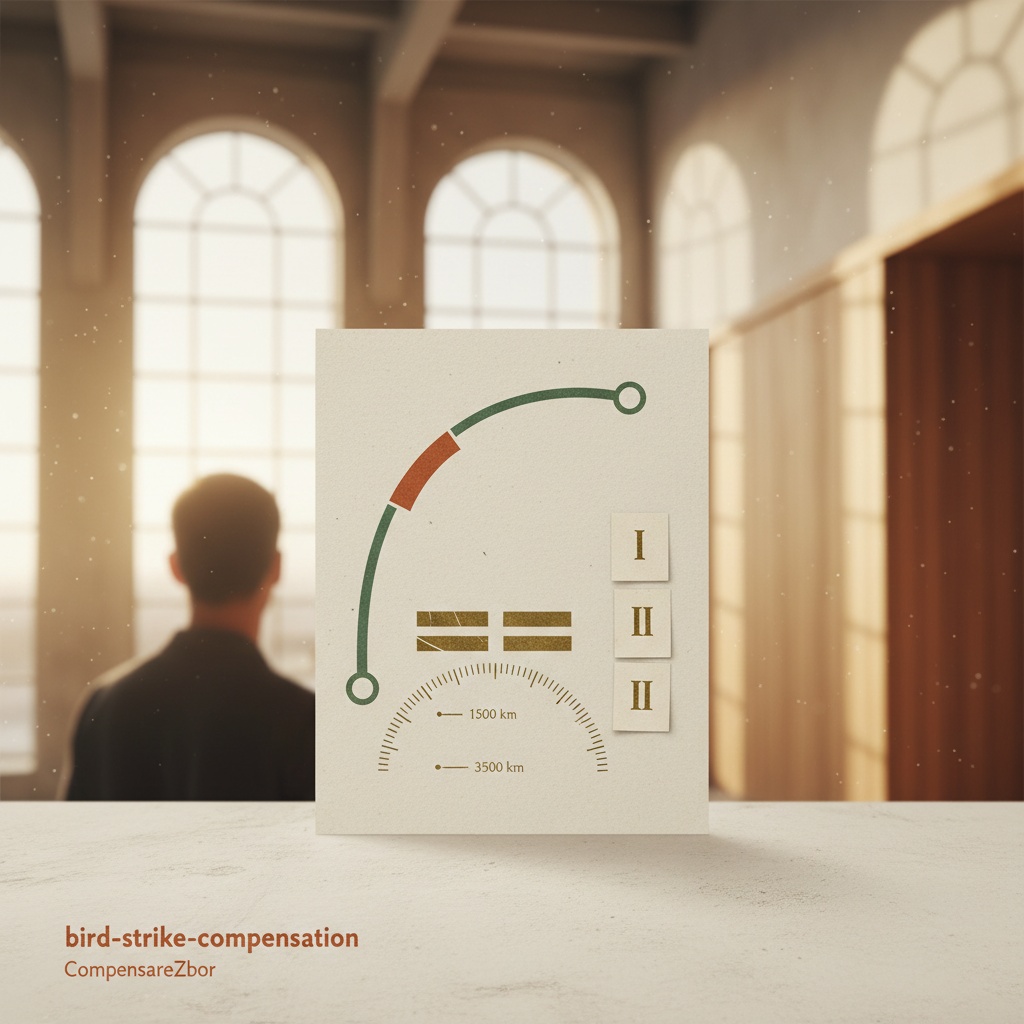
Split the delay in two and ask which half the bird explains. The safety inspection after a strike is an EASA airworthiness requirement, not an airline choice. Everything after it — no technicians at Otopeni at that hour, a missing slot, no contingency aircraft for a Cluj rotation — is the airline’s, and Wallentin-Hermann puts the burden of proving otherwise on the carrier:
Part one — the necessary safety inspection. After a bird strike, the aircraft must be inspected before it can fly again. Engines, leading edges, sensors and the fuselage are checked for damage; that is a hard safety requirement set by EASA airworthiness directives, not an airline choice. The time strictly needed for that inspection is a direct consequence of the extraordinary event and is not claimable under Pešková.
Part two — everything else. If it then took a long time because the airline had no technicians on station at Otopeni at the relevant hour, because it was waiting for a slot at a foreign airport, because it had no contingency aircraft for a Cluj rotation, or because the operations centre simply handled the case slowly — that part is about the carrier’s own organisation. The airline could have prevented it.
If your total delay at the final destination reaches three or more hours at arrival and a meaningful share of that delay is down to the second category, the compensation question is open — despite the bird strike. The three-hour threshold was imported into EU 261 by the CJEU in Sturgeon and Böck (joined cases C-402/07 and C-432/07, 2009), and it applies to any cause, bird strikes included. Compensation is fixed at 250 EUR for flights up to 1,500 km, 400 EUR for intra-EU flights over 1,500 km and other flights of 1,500–3,500 km, and 600 EUR for all other flights — typical Bucharest–London or Bucharest–Madrid routes fall in the 400 EUR band.
Crucially, the burden of proof lies with the airline, not with you. The Court set that rule out forcefully in Wallentin-Hermann (C-549/07, 2008): when a carrier wants to rely on the extraordinary-circumstance defence, it must demonstrate both the extraordinary nature of the event and the reasonable measures it took. A one-line “bird strike — beyond our control” reply does neither, and Romanian small-claims judges have shown willingness to reject it.
What “reasonable measures” looks like in a Romanian case
The test is concrete, not abstract, and a refusal that skips it has not done the work Pešková requires. Four questions do the job, and they should be put back to the carrier line by line: when the inspection began and ended, why the wait after it ran to hours, what re-routing was offered, and what contingency aircraft was available:
| Question to the airline | Why it matters |
|---|---|
| When did the inspection actually start? | A long gap between landing and the start of inspection points to organisational delay, not the bird. |
| Were technicians on station at the airport? | Hub airlines should have line maintenance at their main bases — absence at Otopeni for a Romanian carrier is on the carrier. |
| Was a replacement aircraft considered? | For a hub-and-spoke airline, sub-fleeting a rotation is a standard contingency measure. |
| Was crew duty time managed? | If the flight was cancelled because the crew "timed out" waiting for the inspection, that is a roster decision the carrier controls. |
| Were passengers re-routed onto partner flights? | Article 8 of EU 261 entitles passengers to re-routing under "comparable transport conditions" — refusing this widens carrier exposure. |
A refusal that does not address these points has not done the legal work Pešková requires. Romanian passengers should write back asking, line by line: at what time did the inspection start and end, why did the post-inspection wait last hours, what re-routing was offered, and what contingency aircraft was available. The carrier cannot answer with silence and still rely on the bird-strike defence.
For a wider review of what counts as extraordinary and what doesn’t, see our Romanian-language guide on extraordinary circumstances, or for the underlying entitlement framework in English read cancelled flight compensation.
The duty of care applies regardless
Even when the bird strike fully releases the airline from cash compensation, one obligation does not move: the duty of care under Articles 5(1)(b) and 9 of EU 261. While you wait, the carrier must provide meals and drinks proportionate to the wait, two free phone calls or emails, and — when the delay extends overnight — hotel accommodation plus transport between the airport and the hotel.
The CJEU sealed this point in McDonagh (C-12/11, 2013), the famous Icelandic-ash case. The Court held that the care duty has no monetary cap and survives even a long-running extraordinary event. The right is tied to the disruption itself, not to who or what caused it — a bird does not remove the airline’s obligation to look after you.
If the carrier fails to organise care, keep every receipt for food, water, transport and accommodation. Reasonable out-of-pocket costs are reclaimable from the airline even when the 250–600 EUR cash compensation is not owed. The mechanics are covered in detail in our guide on the right to care, meals and hotel, and where a bird strike causes you to miss an onward leg, the entitlement and re-routing rules in missed connection compensation also apply.
How to escalate a bird-strike refusal in Romania
Two layers, neither of which needs a lawyer. ANPC takes the complaint with the booking, boarding pass and refusal letter attached but cannot order payment. And the Judecătoria takes claims up to 10,000 lei in the simplified small-claims procedure, while the European Small Claims Procedure under Regulation 861/2007 covers only cross-border cases:
Step 1 — ANPC (Autoritatea Națională pentru Protecția Consumatorilor). ANPC handles consumer complaints against traders, airlines included. It is also Romania’s national enforcement body for Regulation 261/2004, designated by Government Decision (HG) no. 1912/2006. File a complaint online or at the regional county office, attaching the booking, boarding pass, the airline’s refusal letter and any correspondence. ANPC will not order payment but it puts written pressure on the carrier and creates an enforcement record that supports a court claim later. This is the cheapest first move and usually takes 30–60 days.
Step 2 — Judecătoria (small-claims court). If the airline still refuses, the case goes to the Judecătoria, Romania’s first-instance court for civil claims of moderate value. In cross-border cases, the European Small Claims Procedure (Regulation 861/2007) allows claims up to 5,000 EUR on a standard form, in the language of the court, often without a lawyer. The CJEU confirmed in Rehder (C-204/08, 2009) that the passenger may sue either at the departure court or at the destination court, which means a passenger flying out of Bucharest Otopeni can file at the Judecătoria Buftea even if the airline is based abroad.
The Romanian three-year prescription period under Article 2517 of the Civil Code applies to EU 261 claims. The CJEU confirmed in Cuadrench Moré (C-139/11, 2013) that national limitation rules govern these claims, so Romanian passengers have three years from the flight date to file — considerably longer than the 60-day or 6-month deadlines some airlines print in their conditions of carriage. Those internal caps are not binding on Romanian consumers.
If you would rather not handle the paperwork yourself, a no-win-no-fee specialist can take the file end to end. Check whether AirHelp can claim your bird-strike compensation on a no-win-no-fee basis — they handle the ANPC and Judecătoria escalation and only charge a percentage if money actually lands in your account.
Quick checklist for a Romanian passenger after a bird-strike disruption
Six steps, and the first is the case itself: record the landing time, the moment the crew announced the bird strike and the actual departure, because the split between necessary inspection and excess wait decides everything. Then evidence at the airport, care claimed on the spot, a written demand for the time breakdown, and escalation if a boilerplate refusal arrives:
- Note the timeline. Record landing time, the moment crew announced a bird strike, and the actual departure or cancellation time. The split between necessary inspection and excess wait is the whole case.
- Collect evidence at the airport. Take photos of the departure board, save the airline app screen showing the cancellation reason, and ask the gate agent for the written reason for the delay.
- Claim care on the spot. Vouchers for meals or hotel if offered — keep receipts if you arrange them yourself.
- Write the airline within 7 days. Specific demand: explain the bird strike does not automatically remove compensation, ask for the inspection-versus-handling time breakdown, and claim 250–600 EUR plus reimbursement of care costs.
- If refused with a boilerplate, escalate. ANPC first, then the Judecătoria. The three-year window from the flight date is generous — there is no need to rush, but do not let it lapse.
- Read also: cancelled flight compensation for the underlying entitlement framework, and the Romanian-language version of this guide at /compensare-coliziune-pasare/ if you would rather share it with family in Romanian.
This is not legal advice
This page is built from EU Regulation 261/2004, published CJEU case law and Romanian enforcement practice as of June 2026. It is general information, not legal advice on any individual flight. For your specific situation contact ANPC (consumer protection and the Romanian National Enforcement Body for air passenger rights) or a licensed Romanian lawyer. Bird-strike case law continues to develop at the lower-court level across the Member States — we date and update this page when the CJEU or EUR-Lex issues something new.
Frequently asked questions
Five questions close the bird-strike case: whether a collision rules out EU 261 in Romania, what the Court decided in Pešková (C-315/15), whether a five-hour delay out of Bucharest after a strike is claimable, whether meals and a hotel remain owed, and how long Romanian law leaves to file.
Does a bird strike mean I cannot get EU 261 compensation in Romania?
Not for the collision itself. The CJEU ruled in Pešková (C-315/15, 2017) that a bird strike is an extraordinary circumstance under Article 5(3) of EU 261/2004, so the airline is not liable for the time strictly needed to inspect the aircraft. However, the same judgment makes clear that the airline must also prove it took all reasonable measures to limit the resulting delay. If your total delay at Bucharest, Cluj or any Romanian arrival airport reaches three hours and a large share of that delay was caused by the carrier’s own handling — missing technicians, slow paperwork, no spare aircraft — the 250–600 EUR can still be owed for that part.
What did the CJEU decide in the Pešková case C-315/15?
The Pešková case concerned a flight delayed after the aircraft collided with a bird. The Court of Justice answered two questions. First, a bird strike is an extraordinary circumstance under Article 5(3) of EU 261 because the event lies outside the air carrier’s actual control. Second, that finding does not release the airline from showing it took every reasonable measure to limit the knock-on delay. Both halves of the ruling bind Romanian courts, including the Judecătoria.
My flight from Bucharest was delayed five hours after a bird strike — can I claim?
Possibly. Ask the airline in writing to break the five hours into two parts: how long the mandatory safety inspection actually took, and how long was spent waiting for technicians, parts, slot clearance or a replacement aircraft. The first part is normally covered by Pešková and not claimable. The second part is the airline’s own organisational risk, and if it accounts for a significant share of the delay, the EU 261 compensation of 250–600 EUR can still apply for that portion. The burden of proof under Wallentin-Hermann (C-549/07) sits on the airline.
Am I still entitled to meals and a hotel after a bird strike delay?
Yes. The duty of care under Articles 5(1)(b) and 9 of EU 261 applies regardless of the cause. The CJEU confirmed in McDonagh (C-12/11, 2013) that this obligation has no monetary cap and survives even a valid extraordinary circumstance. So even when the bird-strike defence holds and the 250–600 EUR cash compensation is not owed, the airline must still provide meals and drinks during the wait, two free phone calls or emails, and a hotel plus airport transport when the delay runs overnight. Keep every receipt if you had to organise care yourself.
How long do I have to file a bird-strike claim under Romanian law?
Three years from the flight date. Article 2517 of the Romanian Civil Code sets a three-year general prescription period, and the CJEU confirmed in Cuadrench Moré (C-139/11, 2013) that national limitation rules govern EU 261 claims. That is considerably longer than the 60-day or 6-month deadlines some airlines print in their conditions of carriage — those internal caps are not binding on Romanian consumers. You can complain to ANPC as the national enforcement body or file at the Judecătoria within the three-year window.
Sources and further reading
- EUR-Lex — Regulation (EC) No 261/2004 (consolidated text)
- EUR-Lex — CJEU Pešková C-315/15 — bird strike is extraordinary, but airline must still show reasonable measures
- EUR-Lex — CJEU Wallentin-Hermann C-549/07 — narrow reading of extraordinary circumstances and burden of proof
- EUR-Lex — CJEU Sturgeon C-402/07 (joined with C-432/07) — the three-hour delay rule
- EUR-Lex — CJEU McDonagh C-12/11 — care duty survives extraordinary events
- EUR-Lex — CJEU Cuadrench Moré C-139/11 — national limitation periods apply (3 years in Romania)
- ANPC — Autoritatea Națională pentru Protecția Consumatorilor, consumer complaints handler


No comments yet